

Every year, tens of thousands of African families face the same impossible situation. A cancer diagnosis arrives. The local hospital lacks the equipment to treat it properly. The nearest specialist has a waiting list that stretches months. And the most advanced treatments, bone marrow transplants, robotic surgery, and proton therapy simply do not exist in the country.
For those who can afford to look elsewhere, one destination comes up more than any other: India.
A 2024 study published in JCO Global Oncology surveyed oncologists across 17 African countries about where they send cancer patients for treatment abroad. Ninety-four percent named India, not the United States, not Germany, not Thailand. India.
This article looks at why. It covers the data behind the trend, the specific reasons patients and doctors choose India, what the journey actually costs, and what the experience looks like from the perspective of patients who have made that trip.
- The State of Cancer Care in Africa :Why African Patients Choose India for Cancer Treatment
- India Is the Top Destination: Why African Patients Choose India for Cancer Treatment
- Why African Cancer Patients Choose India : Why African Patients Choose India for Cancer Treatment
- Cancer Types Most Commonly Treated in India by African Patients : Why African Patients Choose India for Cancer Treatment
- Cost Comparison: What You Actually Pay : Why African Patients Choose India for Cancer Treatment
- What the Journey Looks Like From Diagnosis to Return : Why African Patients Choose India for Cancer Treatment
- Challenges and What Patients Should Know : Why African Patients Choose India for Cancer Treatment
- Top Hospitals for African Cancer Patients in India : Why African Patients Choose India for Cancer Treatment
- Conclusion: Why African Patients Choose India for Cancer Treatment
The State of Cancer Care in Africa :Why African Patients Choose India for Cancer Treatment
To understand why African patients travel to India for cancer treatment, you have to understand what they are dealing with at home.
Cancer is rising fast across Africa. According to the International Agency for Research on Cancer (IARC), over 61% of new global cancer cases in 2022 occurred in low- and middle-income countries. The burden falls hardest on countries that are least equipped to handle it.
The table below shows estimated cancer cases and deaths across the six African countries that send the most patients to India for treatment.
These are IARC estimates and should be treated as indicative figures, since underreporting is a known problem across the region.
| Country | Est. New Cases/Year | Est. Cancer Deaths/Year | Most Common Cancer (Men) | Most Common Cancer (Women) |
| Nigeria | 102,100 | 71,500 | Prostate | Breast |
| Ethiopia | 60,000+ | 48,000+ | Liver | Cervical |
| Kenya | 47,900+ | 33,000+ | Prostate | Breast |
| Tanzania | 44,000+ | 31,000+ | Prostate / Kaposi Sarcoma | Cervical |
| Ghana | 25,000+ | 16,000+ | Prostate | Breast |
| Uganda | 35,000+ | 23,000+ | Prostate | Cervical |
Source: IARC Cancer Today Database (2022 estimates). Nigeria figures are from IARC 2024 data as cited in CMCS Health. All figures are likely undercount true burden due to underreporting.
The problem is not just incidence. It is what happens after diagnosis.
Radiotherapy machines are scarce across sub-Saharan Africa. Data from the International Atomic Energy Agency shows that most countries in the region have fewer than one linear accelerator per million people, far below the internationally recommended minimum.
Bone marrow transplant programs are nearly nonexistent in most of Africa. Oncologists are in short supply. Chemotherapy drugs, essential for standard treatment protocols, are frequently unavailable or unaffordable.
The gap becomes starkest when you compare specific treatment availability side by side.
| Treatment | Sub-Saharan Africa | India |
| Chemotherapy | Available in major cities; drug shortages common | Widely available |
| Radiotherapy (EBRT) | Fewer than 1 machine per million in most countries | 700+ linear accelerators nationwide |
| Bone Marrow Transplant (BMT) | No functional program in most countries | 200+ accredited BMT centers |
| Robotic Surgery | Limited to a few private centers | Widely available at major hospitals |
| Proton Beam Therapy | Not available | Available (Apollo Hospitals, Chennai) |
| PSMA PET/CT Imaging | Not available in most countries | Available at major cancer centers |
| Targeted Therapy | Limited drug availability and supply reliability | Widely available |
| Immunotherapy | Very limited, high cost | Available at major oncology centers |
| CAR-T Cell Therapy | Not available | Available at select centers |
| Multidisciplinary Tumor Board | Uncommon | Standard at major cancer hospitals |
| Genome Profiling | Not available in most countries | Available; used to guide targeted therapy |
Source: IAEA radiotherapy resource data; CMCS Health treatment availability data; hospital-published service listings.
The result of these gaps is predictable: patients are diagnosed late, often at advanced stages when treatment is hardest.
Many never receive the full course of treatment their condition requires. For patients with the financial means to act, the question is not whether to go abroad. It is where.
India Is the Top Destination: Why African Patients Choose India for Cancer Treatment

The JCO Global Oncology study by Rubagumya et al. (2024) is the most rigorous data available on this topic.
It surveyed 52 oncologists, surgeons, and cancer physicians across 17 African countries. Most respondents (55.8%) were from East Africa, including Tanzania, Kenya, and Rwanda.
The core finding: 92% of respondents knew patients who had referred themselves abroad for cancer treatment. Seventy-five percent had personally referred patients abroad.
And when asked where, 94% named India as their primary destination. The next highest answer was other African countries, at 38.5%.
Referral volumes varied by region.
| African Region | Median Patients Referred Abroad Per Year | IQR |
| Southern Africa | 10 | 3.5 to 13.5 |
| Eastern Africa | 3.5 | 1.0 to 5.75 |
| Western Africa | 2.0 | 1.0 to 7.0 |
| Northern Africa | 0.5 | 0.0 to 1.0 |
Source: Rubagumya et al., JCO Global Oncology, 2024.
Southern Africa’s higher volumes reflect the fact that South Africa itself has stronger oncology infrastructure than most of the continent, which means oncologists there are more comfortable coordinating complex referrals.
East Africa sends fewer patients per doctor, but the sheer number of oncologists in East Africa makes it collectively a significant source of patient flow to India.
The financial scale behind this movement is large. Nigeria alone spends an estimated $1 billion per year on international healthcare, with roughly 60% of that going to oncology, orthopedics, nephrology, and cardiology, according to research cited in the JCO Global Oncology study. These are not small numbers for a country’s healthcare economy.
When oncologists were asked why they referred patients abroad, and why patients self-referred, the answers were consistent but not identical.
| Reason for Physician Referral Abroad | % of Respondents |
| Greater availability of technology (radiotherapy, etc.) | 51% |
| More skilled/specialized workforce | 23% |
| Higher quality of care in receiving country | 15% |
| Greater availability of medicine | 6% |
| Other | 5% |
Source: Rubagumya et al., JCO Global Oncology, 2024.
Physicians focus on technology. Patients focus on trust. Both lead to the same destination. India’s position in this market is not accidental. The country has spent decades building oncology infrastructure that most of sub-Saharan Africa lacks, at a price point that is within reach of middle-income patients who would have no realistic options in Western countries.
Why African Cancer Patients Choose India : Why African Patients Choose India for Cancer Treatment
1. Cost That Makes Treatment Possible : Why African Patients Choose India for Cancer Treatment
The single most important enabling factor is cost. Cancer treatment in India typically runs 60 to 80% below what the same treatment would cost in the United States, Western Europe, or at top private hospitals in parts of Africa.
The table below shows indicative cost estimates across several cancer types. These are hospital-quoted package estimates, not standardized government data, and actual costs will vary by hospital, stage, and treatment protocol. Use them as a starting point, not a final figure.
| Cancer Type | India (USD) | Kenya (USD) | Nigeria Private (USD) | South Africa (USD) | US (USD) |
| Breast Cancer | $5,000 – 6,500 | $11,000+ | $10,000+ | $12,000+ | $18,000+ |
| Cervical Cancer | $2,500 – 3,000 | $6,000+ | $5,000+ | $6,500+ | $9,000+ |
| Prostate Cancer | $4,000 – 9,000 | $10,000+ | $9,000+ | $15,000+ | $25,000+ |
| Colorectal Cancer | $4,000 – 6,000 | $8,000+ | $7,000+ | $9,000+ | $15,000+ |
| Lung Cancer | $4,000 – 6,500 | $9,000+ | $8,000+ | $10,000+ | $20,000+ |
| Blood Cancer / BMT | $25,000 – 30,000 | $40,000+ | $36,000+ | $60,000+ | $80,000+ |
| Brain Cancer | $6,500 – 9,000 | $15,000+ | $13,000+ | $14,500+ | $40,000+ |
| Bone Cancer | $6,000 – 8,000 | $12,000+ | $10,500+ | $13,000+ | $25,000+ |
| Skin Cancer | $2,000 – 3,000 | $5,500+ | $4,800+ | $6,000+ | $10,000+ |
| Stomach Cancer | $3,500 – 5,000 | $8,000+ | $7,000+ | $9,000+ | $18,000+ |
Source: Hospital-published package estimates from major Indian cancer centers including Hanumanay Healthcare, CMCS Health, and Apollo Hospitals Information Centre. Figures are indicative and cover standard treatment costs. They do not include travel, accommodation, or companion costs.
The savings are consistent across cancer types, but they are most dramatic at the top end. A bone marrow transplant that costs $25,000 to $30,000 in India runs $80,000 or more in the United States.
For a family in Nigeria or Kenya, that difference is not marginal. It is the difference between treatment and no treatment.
One important nuance from the JCO Global Oncology study: cost ranked surprisingly low (7th out of 7 reasons) when oncologists were asked why patients self-refer abroad.
Patients say they go for quality, not price. But cost is what makes the decision actionable. A patient may be motivated by quality, but if India were as expensive as the US, they could not act on that motivation.
2. Access to Technology That Does Not Exist at Home : Why African Patients Choose India for Cancer Treatment
When oncologists in the JCO study were asked about their primary reason for referring patients abroad, the most common answer was greater availability of technology, cited by 51% of respondents.
This is the most concrete driver, and it is worth understanding what “technology” actually means in this context. It is not about having better equipment in a general sense. It is about the complete absence of certain treatments in most of Africa.
Radiotherapy is a standard part of treatment for breast cancer, cervical cancer, prostate cancer, brain tumors, and many other cancers. Yet the IAEA has documented that most sub-Saharan African countries operate fewer than one linear accelerator per million people. India has over 700 machines across its major cancer centers.
Bone marrow transplant is the best-available treatment for many leukemias, lymphomas, and multiple myeloma cases. Most African countries have no functional BMT program at all. India has over 200 accredited BMT centers. The result is that blood cancer patients from Africa who want a genuine chance at remission have no realistic option on the continent.
Beyond these two, India’s oncology centers routinely offer imaging and procedures that are either unavailable or severely limited in Africa: PSMA PET/CT for accurate prostate cancer staging, FDG PET/CT and DOTA PET/CT for other staging applications, genome profiling to guide targeted drug selection, CAR-T cell therapy for certain blood cancers, CyberKnife and Gamma Knife radiosurgery for brain tumors, and proton beam therapy for cancers requiring precision radiation near critical structures.
These are not optional upgrades. For specific cancer types at specific stages, they determine whether treatment works.
3. The Quality Perception Factor : Why African Patients Choose India for Cancer Treatment
The top reason cited by 93% of oncologists in the JCO Global Oncology study for why patients travel abroad was the perception of higher quality of care in foreign health institutions.
The word “perception” matters. A separate study cited in the same paper estimates that only about 10% of patients who self-refer abroad truly need care that is unavailable locally. The majority could, in theory, be treated at home. But they go anyway because of a documented lack of trust in local systems, not always because of an objective treatment gap.
The broader picture of reasons for self-referral shows how layered this is.
| Reason for Self-Referral Abroad | % Who Ranked It in Top 3 |
| Perception of higher quality of care in foreign institutions | 93% |
| Mistrust in the local health system | 71% |
| Social prestige associated with international treatment | 61% |
| Better provider communication abroad | 38% |
| Solicitation from foreign referral systems | 37% |
| Fear of stigma | 22% |
| Lower cost of services abroad | 10% |
Source: Rubagumya et al., JCO Global Oncology, 2024. Respondents rated reasons on a scale of 1 to 7; figures above reflect those rating the reason in positions 1 to 3 (most common).
India addresses the trust gap partly through formal accreditation. Leading Indian cancer hospitals hold NABH (National Accreditation Board for Hospitals) certification, and many also carry JCI (Joint Commission International) accreditation, the international standard used to evaluate hospitals against global quality benchmarks.
Standard tumor board reviews, where multiple specialists review each patient’s case together before deciding on a treatment plan, are routine at top Indian cancer centers.
This kind of formal oversight is rare at most African hospitals, not because the doctors are less skilled, but because the systemic infrastructure to support it does not exist.
4. Faster Access to Specialists : Why African Patients Choose India for Cancer Treatment
In most African public healthcare systems, a cancer diagnosis can mean waiting months for a specialist appointment and longer still for treatment to begin.
In India, most major cancer hospitals can schedule an initial consultation within one to two weeks of receiving medical records. Treatment typically starts within days of the consultation.
For aggressive cancers like triple-negative breast cancer, certain leukemias, or late-stage lung cancer, this speed matters. Delays allow cancer to progress.
A patient who waits three months for a bed in a Nigerian hospital is not waiting for free the disease continues to advance. Faster treatment start dates can directly affect outcomes.
Many Indian hospitals now offer remote case review before the patient travels. A patient uploads their reports, biopsy slides, and imaging. An oncologist reviews the case and provides a preliminary treatment plan and cost estimate within 48 to 72 hours.
This removes most of the uncertainty before the patient books a flight, which is both practically useful and psychologically important for families under enormous stress.
5. Language and Cultural Familiarity: Why African Patients Choose India for Cancer Treatment
English is the primary medium of instruction across most of Anglophone Africa. Nigerian, Kenyan, Ugandan, Tanzanian, and Ghanaian patients can communicate directly with Indian doctors and nursing staff without interpreters. This is not the case in Germany, South Korea, or many other medical tourism destinations.
Beyond English, several major Indian hospitals have hired Swahili-speaking case managers specifically to support East African patients.
French interpreters are available for Francophone West African patients at many facilities. Halal dietary options are standard at top hospitals, which matters for a significant proportion of Muslim patients from Nigeria, Somalia, Kenya, and parts of East Africa.
Some hospitals, particularly BLK-Max, Fortis, and Apollo, have dedicated African patient liaison desks that handle visa support, airport pickup, accommodation coordination, and daily communication throughout the stay.
Patients consistently mention this human infrastructure as one of the most valued parts of the experience.
6. Government Referrals and Institutional Support : Why African Patients Choose India for Cancer Treatment

One aspect of this trend that rarely gets discussed: a significant share of African patients traveling to India do not go entirely on their own funds. They go because their government sent them.
The JCO Global Oncology study found that 55% of respondents work in countries where the government has a formal sponsorship program for referring cancer patients abroad. The treatments and cancer types covered by these programs reveal exactly where the local infrastructure gap is most severe.
| Treatment Type Covered by Government Programs | % of Programs That Include It |
| Complex oncologic surgeries | 71% |
| Bone marrow transplant | 61% |
| Liver transplant | 39% |
| Radiotherapy | 39% |
| Immunotherapy | 32% |
| Brachytherapy | 25% |
| Chemotherapy (certain cancers) | 21% |
| Chemotherapy (all cancers) | 18% |
Source: Rubagumya et al., JCO Global Oncology, 2024. Based on 28 respondents whose governments have sponsorship programs.
The cancer types most commonly covered by government sponsorship programs tell a similar story.
| Cancer Type Covered by Government Sponsorship | % of Programs That Include It |
| Breast cancer | 46% |
| Leukemia | 39% |
| Multiple myeloma | 36% |
| Colorectal cancer | 29% |
| Prostate cancer | 29% |
| Lymphoma | 21% |
| Lung cancer | 18% |
| CNS tumors | 18% |
| Cervical cancer | 11% |
Source: Rubagumya et al., JCO Global Oncology, 2024.
Government programs tend to cover the treatments and cancer types where local capacity is most clearly absent, such as complex surgery, BMT, and radiotherapy.
What they cover by omission is equally informative: routine chemotherapy for common cancers is rarely covered because, in theory, it should be available locally.
One caveat worth noting: the study found that in approximately 50% of cases, patients with political connections or personal wealth were more likely to receive government sponsorship even when formal eligibility criteria exist. This equity gap is documented, not anecdotal.
Cancer Types Most Commonly Treated in India by African Patients : Why African Patients Choose India for Cancer Treatment
Not all cancers are equally represented in the outbound flow. The JCO Global Oncology study identified the three most common cancer types for which African patients self-refer abroad: breast cancer (49%), hematological malignancies including leukemia and lymphoma (26%), and prostate cancer (16%). Other frequently treated cancers include cervical cancer, colorectal cancer, brain tumors, and lung cancer.
The table below summarizes each cancer type, its relevance to the African patient population, and what India specifically offers.
| Cancer Type | Why It Drives Outbound Travel | What India Offers That Africa Largely Does Not |
| Breast cancer | The leading cancer in women across most of Africa; the triple-negative subtype is more prevalent in West African women | Nipple-sparing surgery, breast reconstruction, HER2-targeted therapy (Herceptin), proton radiation |
| Blood cancers (leukemia, lymphoma, myeloma) | BMT is standard treatment; no functional BMT programs in most of Africa | 200+ accredited BMT centers, CAR-T cell therapy, haploidentical transplant options |
| Prostate cancer | Incidence 41.2/100k in Nigeria vs global avg 29.4; most diagnosed at advanced stage | PSMA PET/CT for accurate staging, Da Vinci robotic prostatectomy, brachytherapy |
| Cervical cancer | Among the highest global rates in several African countries, HPV vaccination rates are low | Pembrolizumab immunotherapy, tisotumab vedotin (ADC) for advanced cases |
| Colorectal cancer | Rising sharply in younger African patients, especially in urban areas | Laparoscopic/robotic colectomy, HIPEC for peritoneal metastases |
| Brain tumors | Specialized neurosurgical oncology is rare in Africa | CyberKnife, Gamma Knife, neuro-navigation, awake craniotomy, intraoperative MRI |
| Lung cancer | Delayed diagnosis is common; advanced staging on presentation | PET/CT-guided biopsy, targeted therapy for EGFR/ALK mutations, and immunotherapy protocols |
| Bone cancer | Limb-sparing surgery uncommon in Africa | Limb-sparing oncologic surgery, bone reconstruction, prosthetics program |
Source: Cancer type prevalence from IARC and CMCS Health/IARC 2024; treatment availability from hospital-published service listings and CMCS Health clinical data.
The common thread across all of these is the same: Africa has the patients and the disease burden. India has the treatment infrastructure. That gap is what drives the patient flow.
Cost Comparison: What You Actually Pay : Why African Patients Choose India for Cancer Treatment
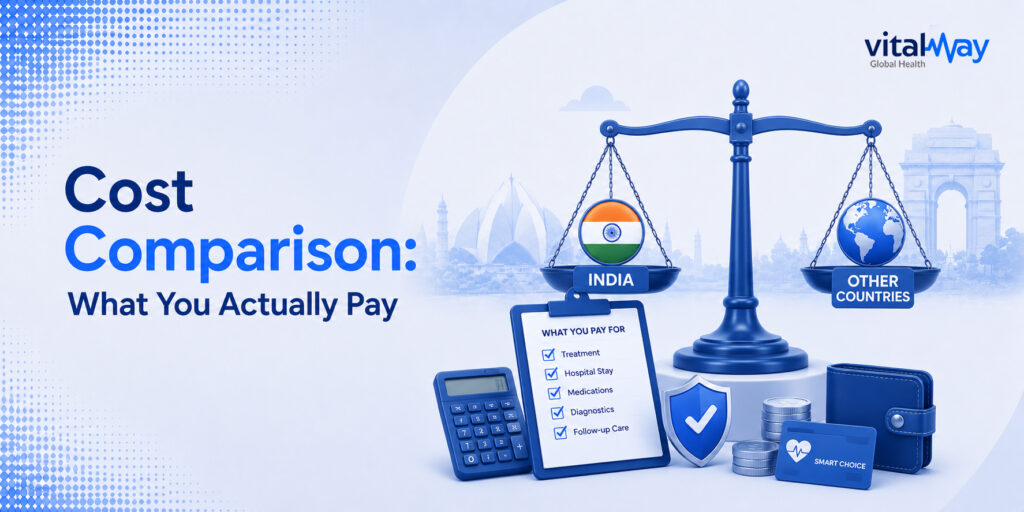
The treatment cost table in Section 3 covers the hospital bill. But hospital bills are not the full picture. Most African families traveling to India for cancer treatment also carry the cost of flights, accommodation, food, local transport, and, in most cases, a companion’s expenses for weeks or months.
The table below provides a rough estimate of total trip cost ranges for two common scenarios: a short surgical case and a longer treatment course. These are estimates based on typical patient experiences reported by medical facilitators and should be used for planning purposes only.
| Cost Component | Short Stay (3 to 5 weeks) | Long Stay (3 to 4 months) |
| Treatment (hospital bill) | $4,000 – $9,000 | $20,000 – $30,000 |
| Return flights (patient + 1 companion) | $1,000 – $2,500 | $1,000 – $2,500 |
| Accommodation (near hospital) | $900 – $2,500 | $3,600 – $10,000 |
| Food and daily expenses | $600 – $1,500 | $2,400 – $6,000 |
| Local transport | $200 – $500 | $800 – $2,000 |
| Miscellaneous (SIM card, incidentals, medications) | $200 – $500 | $800 – $2,000 |
| Estimated Total | $6,900 – $16,500 | $28,600 – $52,500 |
These are indicative estimates. Actual costs vary significantly based on hospital choice, cancer type, treatment complexity, accommodation standard, and number of companions traveling.
The total cost of a bone marrow transplant trip to India including treatment, flights, and accommodation for patient and caregiver typically falls between $30,000 and $55,000.
At $80,000 or more for the same treatment in the United States, India still represents a dramatic saving. But it is not cheap in absolute terms for families in Nigeria, Kenya, or Uganda. Many sell assets, take loans, or rely on community fundraising to cover these costs.
What the Journey Looks Like From Diagnosis to Return : Why African Patients Choose India for Cancer Treatment
Most patients who travel to India for cancer treatment go through a similar sequence of steps, regardless of which country they come from or which cancer they are treating. Here is what that process typically looks like.
Getting a remote opinion first. Most major Indian cancer hospitals will review medical records before a patient travels. Send your pathology report, biopsy slides, imaging CDs, and a summary of previous treatment.
The hospital’s international patient team will forward these to the relevant oncologist. Most respond within two to five working days with a preliminary opinion and treatment estimate. This step is free at many hospitals and should be the first thing any patient does before making any other decision.
Applying for the medical visa. India has a specific medical visa category (MED visa) for patients traveling for treatment. You will need a formal letter from the Indian hospital confirming treatment, along with standard application documents.
Processing typically takes five to ten working days. Most facilitators handle this paperwork as part of their service.
What to bring. Bring all original reports, imaging CDs, and biopsy blocks if possible. Indian hospitals will run their own diagnostic workup on arrival.
Original materials from home speed up the process and sometimes allow the hospital to skip redundant tests. Bring printed copies of everything, not just digital files, and carry them in your hand luggage.
The first two weeks in India. Expect a period of diagnostics and assessment before treatment begins. The hospital will typically run its own blood work, imaging, and in some cases, repeat biopsy to confirm diagnosis and staging.
A tumor board, with multiple specialists reviewing the case together, will then discuss the treatment plan. This review process usually takes three to five working days.
Treatment duration. This varies widely by cancer type and stage. The table below provides typical estimates.
| Treatment / Cancer Type | Typical Stay in India | Key Phases |
| Early-stage breast cancer (surgery) | 3 to 5 weeks | Diagnostics (1 wk), Surgery, Recovery (2 to 3 wks) |
| Prostate cancer (robotic surgery) | 2 to 3 weeks | Diagnostics and staging, Surgery, Recovery |
| Cervical or ovarian cancer (surgery) | 3 to 5 weeks | Diagnostics, Surgery, Recovery, initial chemo if needed |
| Colorectal cancer (surgery) | 3 to 5 weeks | Diagnostics, Surgery, Recovery |
| Brain tumor (surgery) | 3 to 4 weeks | Diagnostics and planning, Surgery, Neurological recovery monitoring |
| Radiation therapy course | 4 to 6 weeks | Daily sessions, 5 days/week; some rest time built in |
| Chemotherapy (all cycles in India) | 3 to 6 months | Multiple cycles, 3 to 4 weeks apart, with monitoring between |
| Chemotherapy (split with home follow-up) | 4 to 8 weeks in India | First 1 to 2 cycles in India; remaining cycles at home with monitoring |
| Bone marrow transplant | 3 to 4 months | Pre-conditioning chemo, Transplant, Post-transplant monitoring |
These are general estimates. Actual stay depends on the individual patient’s condition, complications, and recovery speed.
Coming home. You will receive a detailed discharge summary, follow-up protocol, and contact details for your Indian oncologist. Ask for this in writing and bring physical copies. Arrange for a local oncologist or GP to receive you on return, even if their role is limited to monitoring and relaying information back to India. Identify this person before you leave India, not after.
Challenges and What Patients Should Know : Why African Patients Choose India for Cancer Treatment
Every article on this topic presents India as the obvious answer. Most skip the parts that patients actually need to understand before they commit. The JCO Global Oncology study documents several challenges clearly, and they are worth taking seriously.
| Challenge | What the Data Shows | What to Do About It |
| Total cost exceeds treatment cost | 73% of oncologists cited financial burden as the #1 patient challenge | Get a full cost estimate: treatment + flights + accommodation + food + transport for patient AND companion |
| Loss of continuity after returning | Ranked the 2nd biggest challenge in the PMC study | Identify a local doctor before leaving India; push for a written follow-up protocol; schedule video calls with the Indian team |
| Overuse of diagnostic tests | Flagged by physicians in the PMC study; adds cost and delays treatment start | Ask which tests are essential for the treatment decision and which are standard hospital add-ons |
| Aggressive or unwarranted treatment | Some patients undergo procedures they do not need | Get a remote second opinion from a second Indian hospital before finalizing the treatment plan |
| Active hospital solicitation | 48% of oncologists in the PMC study were aware of foreign hospitals soliciting patients | Use NABH/JCI-accredited hospitals only; verify independently; do not choose based on social media ads |
| Unequal government sponsorship | 50% of cases favor connected or affluent patients even when official criteria exist | Apply through formal channels; know the official criteria and document your eligibility in writing |
| Delayed disease progression | Visa delays, approvals, and logistics can take weeks; cancer does not wait | Start the remote opinion and visa process as early as possible after diagnosis; do not wait until you are in crisis |
| Post-treatment complications managed locally | Local hospitals may not have the context or capacity to manage India-specific protocols | Brief a local doctor fully on the treatment received and provide complete discharge documentation |
Source: Rubagumya et al., JCO Global Oncology, 2024; CMCS Health patient care guidelines; Apollo Hospitals Information Centre patient documentation.
The financial toxicity point deserves particular attention. Even at Indian prices, a bone marrow transplant trip, including flights and accommodation, can cost a family $30,000 to $50,000 in total.
Many middle-income Nigerian and Kenyan families report selling property, taking loans, or running community fundraising campaigns to cover these costs.
Financial ruin from medical travel is not rare. This is not a reason to avoid going for many patients; the alternative is death from an untreated cancer. But it is a reason to go in with a full, realistic budget and not just the hospital’s quoted treatment fee.
The other point worth holding onto: the JCO study found that only about 10% of patients who travel abroad truly need care that is unavailable locally. The other 90% are going primarily because they do not trust local systems.
For those patients, a properly informed second opinion at home from a qualified oncologist, not a GP, might arrive at the same treatment recommendation. If the treatment is genuinely available at home, getting it at home avoids the financial burden, the continuity gap, and the weeks away from family.
Top Hospitals for African Cancer Patients in India : Why African Patients Choose India for Cancer Treatment

The following hospitals are among the most commonly used by African patients for cancer treatment. Accreditation status, key oncology strengths, and African patient support are summarized below.
| Hospital | Location(s) | Accreditation | Oncology Strengths | African Patient Support |
| BLK-Max Super Speciality Hospital | Delhi | NABH | BMT, blood cancers, surgical oncology, haematology | Dedicated African patient team; significant experience with Nigerian and East African patients |
| Fortis Memorial Research Institute | Gurugram | NABH, JCI | Robotic surgery, medical oncology, surgical oncology, immunotherapy | African patient coordinators; large international patient department |
| HCG Cancer Centre | Bangalore, Mumbai, Ahmedabad, others | NABH | Full-range dedicated cancer hospital; radiation oncology, BMT | International patient department; English-first communication |
| Apollo Hospitals | Delhi, Mumbai, Chennai, Bangalore | NABH, JCI | Full range across all campuses; Proton Therapy at Chennai campus | Apollo Information Centres in Nairobi, Addis Ababa, Kampala, and Dar es Salaam |
| Artemis Hospital | Gurugram | NABH | Oncology, BMT, surgical oncology | International patient support; regularly serves East and West African patients |
| Sanar International Hospital | Gurugram | NABH, JCI | Cancer surgery, medical oncology, targeted therapy | International patient desk; English and Arabic-speaking staff |
NABH: National Accreditation Board for Hospitals (India). JCI: Joint Commission International. Both can be verified independently at nabh.co and jointcommissioninternational.org, respectively.
When choosing a hospital, confirm accreditation directly on the relevant body’s website, not from the hospital’s own marketing materials.
Ask specifically whether the hospital has treated patients with your cancer type and stage before, what the multidisciplinary tumor board process looks like, and whether there is a dedicated international patient coordinator who will be your point of contact throughout.
Apollo’s African Information Centres deserve a specific mention for East African patients. These are not call centers. They are offices staffed by local teams in Nairobi, Addis Ababa, Kampala, and Dar es Salaam who handle the full pre-travel process, remote consultation coordination, cost estimates, visa letters, flight guidance, and hospital intake documentation before the patient leaves the continent.
Patients who use these offices consistently report faster, less stressful hospital entry than those who coordinate directly.
Conclusion: Why African Patients Choose India for Cancer Treatment
Ninety-four percent of African oncologists name India as their top destination when referring cancer patients abroad. That figure is not a coincidence.
It reflects decades of India building oncology infrastructure, bone marrow transplant centers, radiotherapy machines, robotic surgery programs, and proton therapy centers that most of Africa does not have, at a price point that is within reach of families who could not consider the United States or Europe.
For families making this decision right now, the practical takeaway is this: India works for cancer treatment, and the data support that. But go in with full cost estimates, not just treatment quotes.
Establish a follow-up plan before you leave the hospital. Use accredited facilities and verified facilitators. And if the treatment you need is genuinely available at home, get a proper oncology second opinion before committing to the trip.
The goal is not to keep sending patients abroad. The goal is to get well.

Related Posts
IVF Treatment Cost in India vs Nigeria and Kenya: A Complete Comparison
Key Takeaways: Couples across Nigeria and Kenya are exploring IVF in growing numbers, and cost is usually...


8 Best Hospitals in Delhi for Cardiac Surgery (2026)
Key Takeaways: When it comes to cardiac surgery, Delhi has quietly become one of the most trusted...