


For anyone dealing with kidney failure, the conversation quickly moves beyond medical decisions to a very practical one: how much is this going to cost, and can we afford it?
In the United States, a kidney transplant can set you back over $400,000. In the UK, the waiting list alone can stretch to two years. In the Gulf, private transplant costs hover between $25,000 and $45,000.
Meanwhile, the same procedure in India, performed by surgeons with decades of experience, in JCI-accredited hospitals, costs between $10,000 and $18,000.
That gap is why thousands of patients from the US, UK, Africa, and the Gulf travel to India every year for kidney transplants. But cost is just one piece of the picture. Before making any decision, you need to understand what is included in that cost, what the legal rules are, how long the process takes, and whether Indian hospitals are actually equipped to handle it safely.
This guide covers all of that, clearly, and without the medical jargon.
- Kidney Transplant Cost in India VS USA, UK: Key Highlights
- How Much Does a Kidney Transplant Cost in India?
- Kidney Transplant in India: Total Cost Breakdown
- Cost of Kidney Transplant in Different Cities of India
- Government vs. Private Hospital Costs For Kidney Transplant in India
- Factors That Affect Kidney Transplant Cost in India
- Legal Policies For Kidney Transplant in India
- Kidney Transplant Cost in India vs. the USA, UK, and Gulf Countries
- Why is a Kidney Transplant So Affordable in India?
- Who Can Donate a Kidney in India? (Donor Eligibility & Legal Rules)
- Success Rate of Kidney Transplant in India
- Is India the Right Choice for Your Kidney Transplant?
Kidney Transplant Cost in India VS USA, UK: Key Highlights
Before diving into the details, here is a quick snapshot of what you are looking at:
- A kidney transplant in India costs $10,000 to $18,000 for international patients
- The same procedure in the USA costs over $400,000
- In the UAE and Gulf, transplant costs range from $25,000 to $45,000
- India’s transplant success rate is 90–95% for one-year patient survival
- International patients must bring their own living donor, a first-degree relative
- The total stay in India for the full process is around 6 to 8 weeks
- Major Indian hospitals, Apollo, Fortis, Medanta, Narayana, are JCI and NABH-accredited
- India runs the second-largest kidney transplant program in the world, after the USA
| Country | Average Cost (USD) | Waiting Time |
| India | $10,000 – $18,000 | Minimal (living donor) |
| UAE / Gulf | $25,000 – $45,000 | Minimal |
| UK (private/international) | $70,000 – $100,000+ | ~2 years (NHS) |
| USA | $350,000 – $442,500 | 3–5+ years |
| Saudi Arabia (private) | $30,000 – $60,000 | Varies |
| Canada | $200,000 – $300,000 | 4–7 years |
How Much Does a Kidney Transplant Cost in India?
The cost of a kidney transplant in India for international patients typically falls between $10,000 and $18,000.
For domestic (Indian) patients, the cost in rupees ranges from approximately ₹5 lakh to ₹15 lakh across private hospitals. Government hospitals are even more affordable, but come with longer wait times.
One important thing to know upfront: if the donor’s blood group is not compatible with the recipient’s, the cost goes up. This is because additional tests, ABO incompatibility workups, and desensitisation protocols are needed. In these cases, the total can push closer to $20,000 to $24,000.
However, this number is not fixed; it moves up or down depending on the hospital you choose, the city you are in, whether the donor’s blood type matches the recipient’s, and how complicated the case is.
Kidney Transplant in India: Total Cost Breakdown
Here is where the money goes when you get a kidney transplant in India:
| Cost Component | Estimated Cost (USD) |
| Pre-transplant evaluation (recipient) | $1,500 – $3,000 |
| Pre-transplant evaluation (donor) | $500 – $1,000 |
| Surgery (recipient) | $5,000 – $8,000 |
| Surgery (donor — laparoscopic nephrectomy) | $1,500 – $2,500 |
| ICU stay (5 days, recipient) | $1,000 – $2,000 |
| Hospital room (ward, 5–10 days) | $800 – $1,500 |
| Medications during hospital stay | $500 – $1,000 |
| Blood tests, crossmatch, tissue typing | $500 – $1,500 |
| Dialysis sessions (if needed pre-surgery) | $300 – $800 |
| Total (approximate) | $11,600 – $21,300 |
Note: These are approximate ranges. Final costs vary by hospital, city, and case complexity.
What This Typically Does NOT Include:
- An extended hospital stay beyond the standard package
- Immunosuppressant medications after discharge (these are a lifetime cost)
- Accommodation for caregivers
- Travel and visa expenses
- Follow-up consultations and labs after discharge
- Specialised meals outside the hospital plan
Package Costs and Timelines
Most top hospitals in India offer all-inclusive transplant packages for international patients. These packages are designed to give you a clear cost upfront, with fewer surprises.
| Item Included | Recipient | Donor |
| Standard hospital stay | 8–10 days | 3–5 days |
| Dialysis sessions (pre-surgery) | Up to 10 sessions | Not applicable |
| Blood tests and gene tests | Yes | Yes |
| All meals (as per treatment plan) | Yes | Yes |
| Medications during stay | Yes | Yes |
| Primary doctor consultations | Yes | Yes |
| Surgery | Yes | Yes |
Package Cost Range
| Blood Group Compatibility | Package Cost (USD) |
| Donor and recipient are compatible | $13,000 – $16,000 |
| ABO-incompatible (blood group mismatch) | $20,000 – $24,000 |
The ABO-incompatible route costs more because the hospital needs to run additional genetic and crossmatch tests, and in some cases, a desensitisation process is required before surgery can proceed.
Timeline for Renal Transplant in India
This is something international patients often underestimate. A kidney transplant in India is not a one-week trip. The full process, from arrival to departure, takes around 6 to 8 weeks.
| Phase | What Happens | Duration (Recipient) | Duration (Donor) | Cost Included? |
| Pre-workup | Medical records review, blood tests, tissue typing, cardiac evaluation, nephrology tests | 3–4 weeks | 3–4 weeks | Not in main package |
| Main treatment | Surgery preparation, transplant surgery, ICU recovery | 8 days | 3 days | Included |
| Post-op monitoring | Kidney function monitoring, infection management, recovery support | 4 weeks | 2 weeks | Not in main package |
This timeline can change based on how healthy the patient and donor are going in. If either has complications during the evaluation phase, the pre-workup period can extend.
Cost of Kidney Transplant in Different Cities of India

India is a large country, and hospital costs vary meaningfully by city. Metro cities like Mumbai and Delhi tend to be more expensive, while cities like Chennai, Hyderabad, and Bangalore offer equally good care at slightly lower prices.
| City | Domestic Cost (INR) | International Cost (USD) |
| Delhi NCR | ₹6,00,000 – ₹11,00,000 | $9,000 – $16,500 |
| Mumbai | ₹7,00,000 – ₹12,00,000 | $10,500 – $18,000 |
| Chennai | ₹5,50,000 – ₹9,00,000 | $8,250 – $13,500 |
| Hyderabad | ₹5,50,000 – ₹9,50,000 | $8,000 – $14,000 |
| Bangalore | ₹6,00,000 – ₹10,00,000 | $9,000 – $15,000 |
| Gurgaon | ₹6,50,000 – ₹11,00,000 | $9,500 – $16,000 |
| Pune | ₹5,50,000 – ₹9,00,000 | $8,000 – $13,500 |
Government vs. Private Hospital Costs For Kidney Transplant in India

This is a question that comes up a lot, especially from Indian patients looking to manage costs.
If you are an Indian patient looking at kidney transplant options, one of the first questions you will ask is whether a government hospital is a viable route. It is a fair question; the cost difference is significant, and for many families, it changes what is even possible.
The short answer is, government hospitals are genuinely good, and some of India’s finest transplant surgeons work in them. But they come with real limitations that make them impractical for a large number of patients, particularly those who cannot afford to wait, and almost entirely impractical for international patients.
| Factor | Government Hospitals | Private Hospitals |
| Cost | ₹1,00,000 – ₹3,00,000 | ₹5,00,000 – ₹15,00,000 |
| Waiting time | Long (months to years) | Short (weeks for living donor) |
| Infrastructure | Adequate to excellent (AIIMS, PGI) | State-of-the-art |
| International patient support | Limited | Full support (visa, interpreter, etc.) |
| Accreditation | Varies | JCI/NABH certified |
| Post-op care | Good but busy | Dedicated transplant coordinators |

Best government hospitals for kidney transplant in India include AIIMS Delhi, PGIMER Chandigarh, and SGPGI Lucknow. These hospitals have excellent surgeons but the waiting lists and infrastructure limitations make them less practical for international patients.
For international patients, private hospitals are the realistic route, they offer dedicated international patient departments, English-speaking staff, visa assistance, and transplant packages.
Top Hospitals for Kidney Transplant in India
Apollo Hospitals has performed over 10,000 kidney transplants and remains one of the highest-volume programs in the country.
Medanta has a dedicated Institute of Kidney and Urology and is well-known for handling complex cases including ABO-incompatible transplants.
CMC Vellore is arguably the most respected transplant program in India from a purely clinical standpoint, though it serves a mix of domestic and international patients.
Here are the hospitals that consistently rank among the best for kidney transplants in India:
| Hospital | Location | Accreditation | Approx. Cost (USD) |
| Apollo Hospitals | Delhi, Chennai, Hyderabad | JCI, NABH | $9,800 – $16,800 |
| Medanta – The Medicity | Gurgaon | JCI, NABH | $9,800 – $15,000 |
| Fortis Memorial Research Institute | Gurgaon | JCI, NABH | $9,000 – $14,500 |
| Narayana Health | Bangalore | NABH | $8,250 – $13,500 |
| Max Super Speciality Hospital | Delhi | JCI, NABH | $10,000 – $14,000 |
| Kokilaben Dhirubhai Ambani Hospital | Mumbai | JCI, NABH | $14,500 – $18,000 |
| Dr. Rela Institute & Medical Centre | Chennai | NABH | $9,000 – $14,000 |
| BLK-Max Super Speciality Hospital | Delhi | JCI, NABH | $11,000 – $15,000 |
| Manipal Hospital | Bangalore, Delhi | NABH | $9,000 – $14,000 |
| Christian Medical College (CMC) | Vellore | NABH | $7,000 – $12,000 |
Factors That Affect Kidney Transplant Cost in India
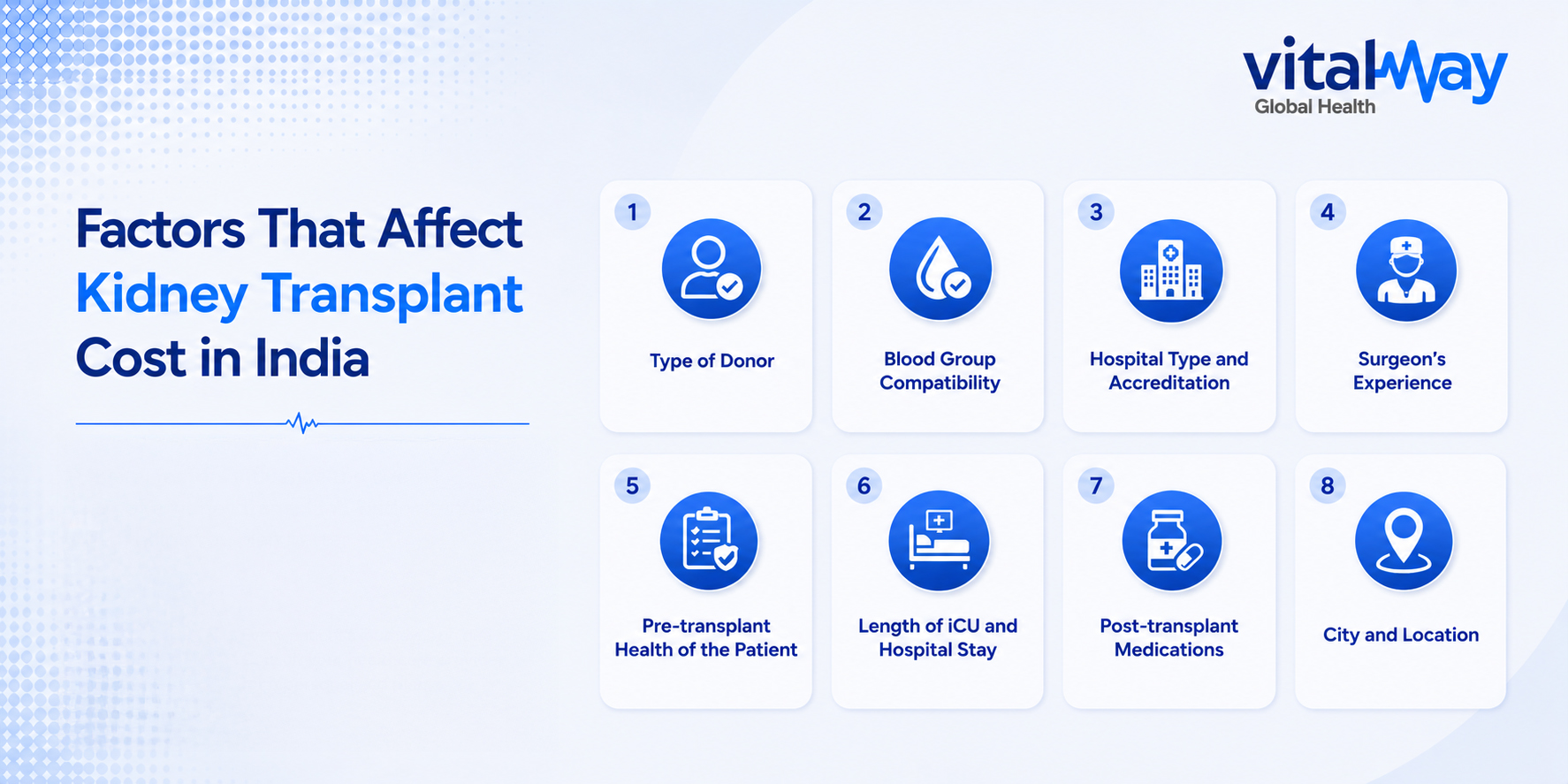
Even within a single city or hospital, the cost can vary quite a bit. Here is what drives that difference:
1. Type of Donor:
Living donor transplants generally cost less and have better outcomes. Deceased-donor (cadaveric) transplants involve procurement costs and are more logistically complex.
2. Blood Group Compatibility
If the donor and recipient have compatible blood types, the surgery can proceed with standard protocols. An ABO-incompatible case requires extra testing and desensitisation, which adds $5,000 to $8,000 to the bill.
3. Hospital Type and Accreditation
A JCI-accredited private hospital in a metro city will cost more than a government hospital in a tier-2 city. Both can deliver good outcomes, but the experience and support infrastructure differ.
4. Surgeon’s Experience
Senior surgeons with 25+ years of transplant experience and high caseloads typically charge more. For a complex case, the difference in outcome is worth it.
5. Pre-transplant Health of the Patient
If the patient has heart disease, severe anaemia, uncontrolled diabetes, or other complications, the pre-transplant evaluation phase becomes longer and more expensive. Additional specialist consultations, procedures, and tests add to the total.
6. Length of ICU and Hospital Stay
The standard ICU stay is around 5 days for the recipient. Complications can extend this significantly, and each additional ICU day adds to the cost.
7. Post-transplant Medications
Immunosuppressant drugs are a lifelong necessity after a kidney transplant. During the hospital stay, these are usually included. After discharge, the monthly cost in India is roughly ₹5,000 to ₹15,000 ($60 to $180), depending on the specific drugs prescribed — far lower than what patients pay in the US or UK.
8. City and Location
As shown in the city-wise table above, Mumbai and Delhi are pricier than Chennai and Hyderabad.
Legal Policies For Kidney Transplant in India
India has strict laws governing organ transplantation, and international patients must understand these before making any plans.
The entire process is governed by the Transplantation of Human Organs and Tissues Act (THOTA), 1994, which has been amended over the years to prevent organ trafficking and ensure ethical practices.
Key points for international patients:
- You must bring your own donor. International patients cannot receive kidneys from India’s national deceased-donor registry. A living donor who is a first-degree relative is required.
- Only first-degree relatives qualify as donors. This means parents, siblings, or children. Second-degree relatives, grandparents, aunts, uncles, cousins are not permitted as donors for international patients.
- The donor must be between 18 and 65–70 years of age.
- An Authorization Committee must approve the transplant. The hospital’s ethics and authorization committee reviews donor-recipient relationships and medical documentation before surgery can be scheduled.
- Organ buying and selling is strictly prohibited. Any attempt to purchase a kidney is a criminal offence in India.
- Both donor and recipient must be present in India for the full evaluation and surgery.
These rules exist for good reason. India has been very deliberate about building a transplant system that cannot be exploited. For legitimate patients with a genuine family donor, the process is well-supported by hospitals.
Kidney Transplant Cost in India vs. the USA, UK, and Gulf Countries
When you put India’s transplant costs next to what the same procedure costs in the USA, UK, or the Gulf, the difference is not marginal; it is the kind of gap that changes what families can actually afford.
The comparisons below are not about India being a budget option with compromised care. They are about a country that has built genuine medical expertise at a cost structure that the West simply cannot match, for reasons that have everything to do with economics and very little to do with quality.
India vs. USA
The USA has the most expensive kidney transplant costs in the world. The full package surgery, procurement, physician fees, pre- and post-transplant care, and medications comes to over $442,000 on average. Even with Medicare coverage (for patients over 65 or those with end-stage renal disease), out-of-pocket costs remain significant.
| Cost Component | USA (USD) | India (USD) |
| Hospital and surgery | $152,300 | $5,000 – $8,000 |
| Donor procurement | $113,900 | $1,500 – $2,500 |
| Post-transplant follow-up | $85,500 | $1,000 – $2,000 |
| Pre-transplant tests | $32,700 | $1,500 – $3,000 |
| Medications | $31,900 | $500 – $1,000 |
| Physician fees | $26,200 | Included in package |
| Total | ~$442,500 | $10,000 – $18,000 |
The savings are not marginal, they are transformational. A patient paying out of pocket in the US could fund their entire India transplant journey, including flights, accommodation, and post-op care, and still save well over $400,000.
India vs. UK
For UK residents, the NHS covers kidney transplants at no direct cost. However, the average waiting time is around two years, and the waiting list has over 6,000 patients at any given time. For patients who cannot wait, or who are not UK residents, private and international treatment costs are significantly higher.
Private kidney transplant costs in the UK for international patients are estimated at $70,000 to $100,000+, which is still far above what India charges.
India offers near-zero waiting time for living donor cases, comparable or better success rates, and a cost that is a fraction of UK private pricing.
India vs. Gulf Countries (UAE, Saudi Arabia, Qatar, Kuwait)
Gulf countries are a major source of medical tourists coming to India. Here is how the numbers compare:
| Country | Kidney Transplant Cost (USD) | Waiting Time |
| India | $10,000 – $18,000 | Minimal |
| UAE (Dubai/Abu Dhabi) | $25,000 – $45,000 | Minimal |
| Saudi Arabia (private) | $30,000 – $60,000 | Varies |
| Kuwait / Qatar / Oman | $20,000 – $50,000 | Varies |
The UAE has some excellent transplant centres, such as the Cleveland Clinic Abu Dhabi, American Hospital Dubai, and is a convenient option for Gulf residents who want to stay close to home. But for patients prioritising cost, India still wins by a significant margin.
Many patients from Saudi Arabia, Kuwait, and Nigeria specifically choose India because they can fly in, get a world-class transplant, and return home having spent less than a third of what UAE hospitals charge.
Why is a Kidney Transplant So Affordable in India?
This is a fair question, and it deserves a straight answer, because the assumption many people make is that lower cost means lower quality. That is not the case here.
1. Lower cost of living drives lower operational costs.
Everything from nursing salaries to hospital maintenance, laundry services to surgical supplies, all cost less in India than in the US or UK. That saving gets passed on to patients.
2. High surgical volume creates efficiency.
India performs more kidney transplants than almost any other country. High volume means hospitals have perfected their protocols, which means fewer complications, shorter stays, and lower costs per procedure.
3. No massive medical liability insurance overhead.
A large chunk of US healthcare costs comes from liability insurance and legal overhead. India’s system does not carry that burden in the same way.
4. Government price regulation.
Certain hospital costs in India are subject to regulatory oversight, which prevents the kind of billing inflation that is common in the US.
5. Surgeons trained to international standards, paid Indian salaries.
Many of India’s top transplant surgeons were trained in the US, UK, or Europe and returned to practice in India. Their skill level is world-class. Their cost structure is not.
6. Competition between hospitals.
India has a large number of high-quality private hospitals competing for patients, especially international ones. This keeps prices honest.
Who Can Donate a Kidney in India? (Donor Eligibility & Legal Rules)

For international patients, this is often the section that makes or breaks the plan.
Unlike many other medical procedures, where you simply book a hospital and fly in, a kidney transplant in India requires you to arrive with a donor.
India does not allow international patients to access its national deceased-donor organ pool, and the laws around who qualifies as a living donor are specific and strictly enforced.
India’s transplant system is governed by the Transplantation of Human Organs and Tissues Act (THOTA), 1994, which has been updated over the years to close loopholes and strengthen ethical safeguards.
Under this law, every transplant involving a living donor must be reviewed and approved by a hospital-based Authorization Committee before surgery can take place. This committee verifies the relationship between donor and recipient, reviews medical suitability, and ensures no financial transaction has taken place in exchange for the organ.
| Relationship | Eligible as Donor for International Patients? |
| Parent | Yes |
| Sibling (brother/sister) | Yes |
| Child (son/daughter) | Yes |
| Spouse | Yes (in most cases, with committee approval) |
| Grandparent | No |
| Aunt / Uncle | No |
| Cousin | No |
| Nephew / Niece | No |
| Unrelated individual | No (for international patients) |
Medical Requirements for the Donor
- Age: 18 to 65–70 years
- Good general health: no active kidney disease, uncontrolled diabetes, or serious heart conditions
- Compatible blood type (or ABO-incompatible process followed)
- Positive crossmatch test (the donor’s kidney should not be rejected by the recipient’s immune system)
- Tissue typing compatibility
Tests Required Before Donation
- Blood typing
- HLA (tissue) typing
- Crossmatch test
- Full medical workup: cardiac evaluation, kidney function tests, imaging
If the crossmatch is negative (which is what you want), the surgery can proceed. If positive, the transplant team will decide whether desensitisation is an option or whether the procedure should not go ahead with that donor.
Success Rate of Kidney Transplant in India

India’s kidney transplant success rates are genuinely comparable to Western standards and in some cases, better, given the shorter waiting times (which means patients arrive in better health).
| Metric | India | USA/UK |
| 1-year patient survival rate | 95 – 98% | 95 – 97% |
| 1-year graft survival rate | 90 – 95% | 90 – 93% |
| Average graft lifespan (living donor) | 15 – 25 years | 15 – 20 years |
| Average graft lifespan (deceased donor) | 10 – 15 years | 10 – 12 years |
These figures are for well-run transplant programs at accredited hospitals. Outcomes at smaller or less experienced facilities may vary.
India’s high surgical volume also contributes to strong outcomes. Experienced teams make fewer mistakes and manage complications more effectively.
Is India the Right Choice for Your Kidney Transplant?
For most international patients dealing with end-stage kidney disease and a willing family donor, the answer is yes, but it depends on a few things.
India makes sense if:
- You have a first-degree relative willing and able to donate
- Your donor and you are medically suitable after evaluation
- You can commit to 6 to 8 weeks in India for the full process
- Cost is a significant concern — and for most people, a saving of $300,000 to $400,000 compared to the US is not something to ignore
- You are coming from the Gulf, Africa, or South Asia, where the flight is manageable
India may not be the best option if:
- You do not have a suitable living donor. India’s rules make it very difficult for international patients to access deceased-donor kidneys
- You have complex comorbidities that require a very specialised transplant centre
- Travel is medically unsafe for you at this stage
For patients who do proceed, India delivers genuinely world-class care. The transplant teams at Apollo, Medanta, Fortis, Narayana, and CMC have handled tens of thousands of cases from around the world. The combination of experienced surgeons, affordable pricing, and strong post-op support infrastructure is difficult to match anywhere else.
FAQs: Kidney Transplant Cost in India
1. What is the exact cost of a kidney transplant in India for international patients?
The cost ranges from $10,000 to $18,000 for blood-type compatible cases. If there is a blood group mismatch (ABO-incompatible transplant), the cost can go up to $20,000 to $24,000. This usually includes the surgery, hospital stay, standard medications, and basic tests.
Can a foreigner get a kidney from an Indian donor?
No. Indian law requires international patients to bring their own living donor, who must be a first-degree relative, parent, sibling, or child. International patients cannot access India’s deceased-donor organ pool.
How long do I need to stay in India for a kidney transplant?
Plan for 6 to 8 weeks in total. The pre-transplant evaluation takes 3 to 4 weeks, surgery and hospital recovery takes about 2 weeks, and post-op monitoring before you are cleared to fly home takes another 3 to 4 weeks.
Is the quality of kidney transplant in India as good as in the US or UK?
Yes. India’s top transplant hospitals have one-year patient survival rates of 95 to 98%, which is on par with leading US and UK centres. Many Indian surgeons trained in the West and returned to practice here. JCI accreditation means these hospitals meet international standards.
What is the success rate of kidney transplants in India?
One-year patient survival is 95 to 98%. One-year graft (kidney) survival is 90 to 95%. With proper post-transplant care and medication adherence, a transplanted kidney from a living donor can function for 15 to 25 years.
Which is the cheapest city in India for a kidney transplant?
Chennai and Hyderabad are generally the most affordable, followed by Bangalore and Pune. Mumbai and Delhi tend to have slightly higher costs due to higher operational expenses.
Is a kidney transplant in India covered by health insurance?
For Indian residents, most comprehensive health insurance policies now cover kidney transplants. For international patients, coverage depends on your home country’s policy. Some international health insurance plans do cover treatment abroad, including in India.
What documents does an international patient need for a kidney transplant in India?
You will need the patient’s complete medical records, passports for both patient and donor, proof of the family relationship between donor and recipient (birth certificate, etc.), blood group and basic blood test reports, and medical visa documentation. The hospital will guide you through what the authorization committee specifically requires.
What are the ongoing costs after a kidney transplant in India?
Once you return home, the primary ongoing cost is immunosuppressant medication, typically $60 to $180 per month if purchased in India, or more depending on your home country. You will also need regular blood tests and nephrology consultations, typically monthly for the first year and quarterly thereafter.

Related Posts

How to Apply for a Medical Visa for India – Complete Guide (2026)
Key Takeaways: Every year, hundreds of thousands of patients from Africa, the Middle East, Southeast Asia, North...


8 Best Hospitals in Delhi for Cardiac Surgery (2026)
Key Takeaways: When it comes to cardiac surgery, Delhi has quietly become one of the most trusted...